



Chinese cloud provider Tencent’s presence in Malaysia has traditionally focused on Platform-as-a-Service (PaaS) and content delivery network (CDN) offerings, to support local customers.
Now, the company is building out full cloud infrastructure, citing Malaysia’s booming digital economy, strong technology ecosystem, reliable energy supply, and cost advantages compared to neighbouring Singapore. Also, data residency is emerging as a key requirement for many companies in major regions like Asia.
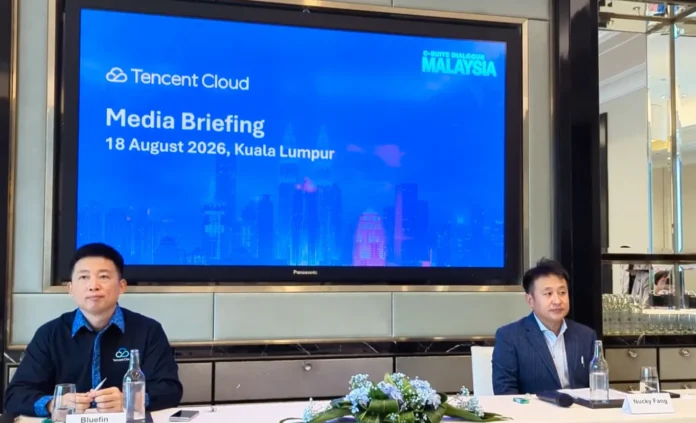
This expansion will see the setting up of up to three availability zones (AZ) in the Malaysian state of Johor. Bluefin Jiannan Zhao, VP of Tencent Cloud and managing director of Tencent Cloud International for APAC, said, “Two (data centres) are already in operation… There’s one upcoming as well, and all three will be located in Johor.”
Tencent Cloud is establishing its first Cloud Region in Malaysia with this expansion in Johor. But, it is not entering an empty market. Chinese cloud player, Alibaba Cloud launched its second Malaysian public cloud region with two new data centres in Johor last June, while Amazon Web Services already operates a Malaysia cloud region with three availability zones.
Meanwhile, Google Cloud committed USD2 billion last May to build its first data centre and Google Cloud region in the country.
Escalating activity
Tencent’s expansion positions it to compete more directly with AWS, Alibaba, Google Cloud, and other hyperscalers for Malaysian and regional cloud and AI workloads.
Its consumer-tech DNA and experience in gaming and social entertainment also gives it an advantage that Bluefin claims lets it win customers in other sectors like financial services, manufacturing, and energy.
Bluefin explained, “Since we have rich understanding in the consumer sector, we customise our technology into our product solutions… that special capability can empower our enterprise-level customers to better serve their end customers. That’s the differentiation between Tencent and our peers in the industry.”
Over the years, Tencent Cloud has quietly laid the groundwork for a larger presence in Malaysia. Recognising current requirements for local data centre presence, Tencent Cloud’s SVP of Tencent Cloud and Head of Tencent Cloud International Poshu Yeung stressed that it is now a key differentiator as more regulated industries look to modernise their IT stacks.
A customer case study
One such organisation is Boost, a Malaysian-born digital financial services group with a homegrown e-wallet that has expanded beyond Malaysia.
Since we have rich understanding in the consumer sector, we customise our technology into our product solutions… that special capability can empower our enterprise-level customers to better serve their end customers. That’s the differentiation between Tencent and our peers in the industryBluefin Jiannan Zhao
Today, Boost is working with Tencent Cloud on a large‑scale and multi-phased migration as it strengthens its digital banking and regional position as a payments and microlending player. Beyond standard metrics like total cost of ownership, resiliency, scalability, and regulatory alignment, Boost’s leadership was persuaded by Tencent’s track record, having observed Tencent Cloud execute a complex migration for another portfolio company within the Axiata Group.
Turning consumer-scale tech into enterprise growth
Boost’s journey began almost a decade ago with the singular vision of solving financial access for an unbanked/underserved market.
Sheyantha Abeykoon, Group CEO of Boost, shared during a C-suite dialogue session, “We started off with payments, then we pivoted and evolved our business into being the largest digital microlender for small business in Malaysia. We extended that to Indonesia…and then we decided that if we were really going to scale and solve the problem, we needed to have a wider stack.”
Sure enough, when the local regulator announced it had digital bank licenses to award suitable candidates, Boost teamed up with RHB Bank. The RHB-Boost consortium was granted a license in 2022 and commenced operations as Boost Bank in January 2024.
Fast forward to 2026, and Boost is migrating to Tencent’s infrastructure also because it sees the Chinese company as being in a similar digital banking business and with a technology stack that is “a little bit like ours but operating at a different scale in China.”
This isn’t a simple infrastructure deal, but a broader technology and business collaboration. (Watch the video to learn how Boost Bank wants to scale with cloud and AI agents.)
With local infrastructure in place, existing partnerships across financial services (Ryt Bank), telecoms (YTL Communications), and enterprise sectors, and a broader push to bring China-honed cloud and AI expertise to Malaysia, Tencent Cloud’s Malaysian expansion signals that it is entering a more assertive, execution-focused phase.
Tencent’s Kuala Lumpur office headcount is on track to reach 500 staff, encompassing engineering, IT, and functional support roles, though the company declined to break down the numbers by department.