

By Ryoji Itako, Business Development Director, Japan & Korea, Acumen Intelligence
Dell Technologies Japan’s newly appointed president, Jon Robottom, urged companies to move beyond AI experimentation and focus on execution, as the technology evolves from a conversational “adviser” into an “operator” capable of performing business tasks.

During his keynote address, Jon said that while the cost of using AI models is falling, token consumption is rising rapidly. According to information released by Dell Technologies in May, annual token consumption increased tenfold to more than 100 trillion tokens in 2025.
Although challenges remain – including the economics of token consumption and data centre power and cooling capacity – he said the discussion is shifting from whether companies should adopt AI to how quickly they can do so.
Jon also highlighted the pace of change, arguing that companies must continually update their knowledge and strategies to adapt to evolving business conditions and security risks.
He presented four findings from survey research on Japanese enterprises:
- 70-percent of Japanese IT leaders cited project silos as a barrier to operational efficiency, with data, workplace and AI initiatives pursued separately by individual departments.
- 53-percent reported struggling to keep pace with rapid technological change.
- 63-percent said their companies had not sufficiently developed innovation roadmaps for AI, data and security.
- 87-percent expected security and resilience to be built into proposals from technology partners.
“I actually find the 53 percent figure to be low,” Jon said. “I suspect there are still companies that haven’t yet realised they need to accelerate their response to change even further.”
Without clear objectives and direction, he added, companies will struggle to achieve results. On expectations for security and resilience, he said, “Ideally, this figure should be 100 percent.”

For Jon, the findings point to a clear priority. “The most important thing is to move from experimentation to execution.” and he called for an integrated approach to AI, data, security and infrastructure, rather than treating them as separate initiatives.
Moving beyond proofs of concept
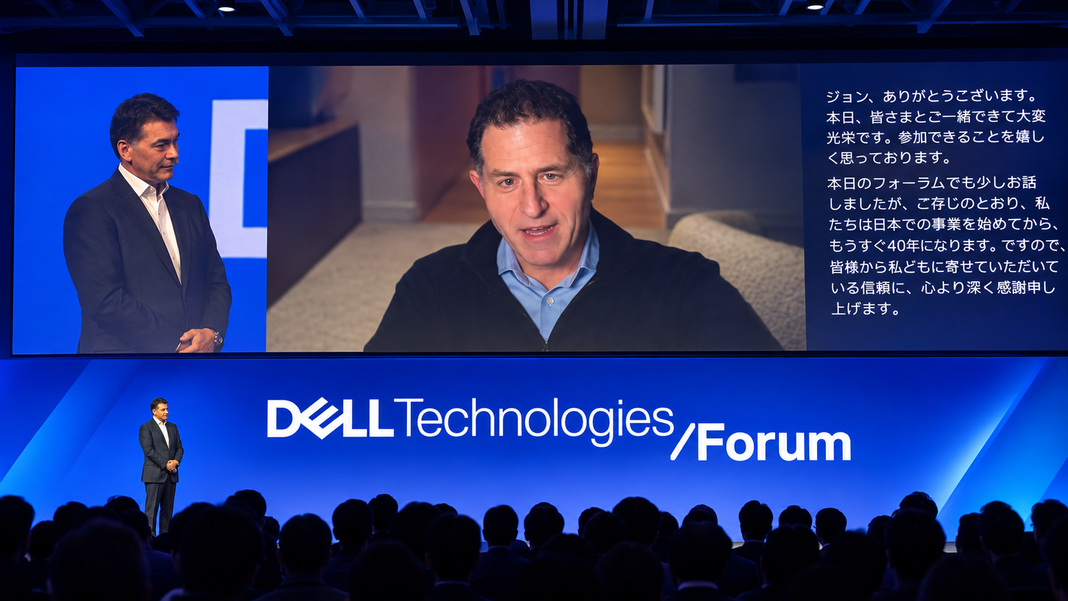
Joining the keynote virtually, Michael Dell said AI is fundamentally changing how companies use technology.
“AI is significantly transforming the way companies utilise technology. In recent years, driven by advancements in technologies such as generative AI, many companies have been exploring new possibilities for improving operational efficiency and creating value,” Michael said.
However, he argued that implementing AI is not an end in itself. What matters is the business results companies achieve with it.

While many organisations have focused on generative AI proofs of concept (PoCs) and pilot deployments, Michael said the next step is to embed AI into core operations, transforming workflows and business processes.
Agentic AI is central to that shift. Whereas traditional AI tools respond to human instructions by providing answers, generating text or analysing information, AI agents can work across systems to gather information, execute tasks and advance business processes.
Michael’s message was that competitiveness will depend less on adopting the latest technology than on identifying high-value use cases, establishing the data and infrastructure needed to support them, and delivering sustained results.
That requires collaboration between executive leadership, business units and IT teams to move beyond isolated experiments towards company-wide transformation.
Assessing tasks, not job titles
John Roese, Dell’s chief technology officer, expanded on the transition from AI as a support tool to AI as a participant in business operations.
While AI has helped employees retrieve information, create documents and analyse data, John said agent-based systems are increasingly capable of executing tasks across multiple systems and data sources.
He advocated assessing AI opportunities at the task level rather than by job title. Dell’s analysis of approximately 6,400 job descriptions found that individual roles often encompass multiple types of work.
Rather than considering whether AI can replace an entire role, companies should break it down into tasks and determine which are suitable for AI and which should remain with people.
John also outlined a growing range of enterprise agents. Alongside tools that support information retrieval and document creation, agents are emerging that perform routine activities such as organising customer relationship management (CRM) data and correcting duplicate records.
Agents that coordinate across business processes are also becoming more practical. One manufacturing case study presented during the keynote showed waiting times in the testing phase falling by approximately 50 percent.
Applications are also expanding into specialised activities such as software development and quote preparation. Creativity, communication and collaboration, meanwhile, remain important areas of human responsibility.
Building a network of agents
John described a future in which multiple AI agents collaborate, with “concierge-type agents” acting as a central point of coordination.

These agents would interpret user requests and route work to specialised agents or systems. He suggested that they could eventually appear in corporate organisational charts.
As adoption expands, governance and security will become increasingly important. Companies will need to assign digital identities to agents and manage their access permissions and the systems they can use.
They will also need a data foundation that enables agents to understand company-specific knowledge and business rules, drawing on knowledge graphs, vector data and API integration.
John emphasised that successful AI deployment depends on more than model performance. It requires an overall design encompassing data, infrastructure, operational management and cost optimisation.
The challenge, he argued, is no longer simply to demonstrate AI’s potential, but to manage it as an organisational capability that delivers continuing business value.