



Held at Monarch Imperial in Colombo, Sri Lanka AI Week 2026 brought together regional enterprise leaders, digital strategists and policy architects to explore the possibilities of AI under the theme ‘AI Amplified’.
Hosted by SLT-MOBITEL alongside the Ministry of Digital Economy, the forum presented a comprehensive overview of the country’s evolving technology stack, spanning interactive trade show demonstrations to high-level policy frameworks.
Moreover, key discussions were delivered by keynote speakers and industry panellists, including Dr Hans Wijayasuriya, Joseph Jones, Varun Rastogi, and senior representatives from across the public and private enterprise sectors.
Digital Public Infrastructure as a Strategic Enabler
A core thread across the opening keynotes focused on Sri Lanka’s macro-economic digital goals.
According to official national frameworks, Sri Lanka aims to expand its digital economy footprint from 3-percent to 12-percent of GDP by 2030.
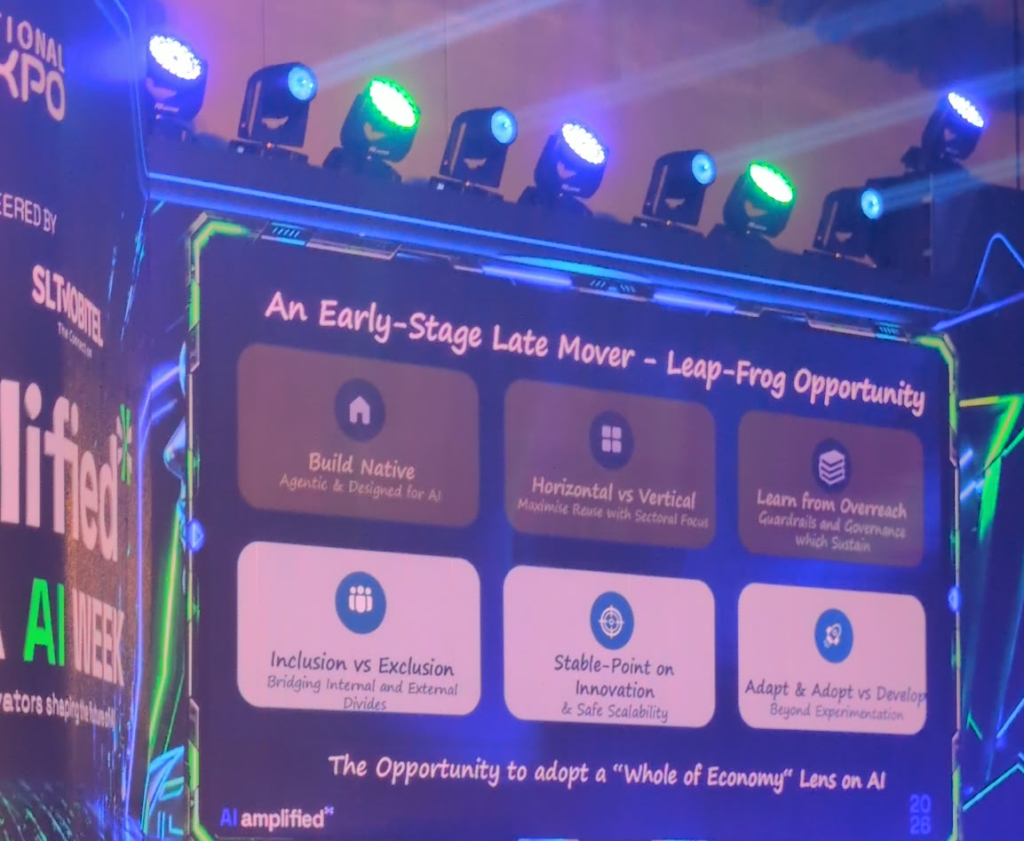
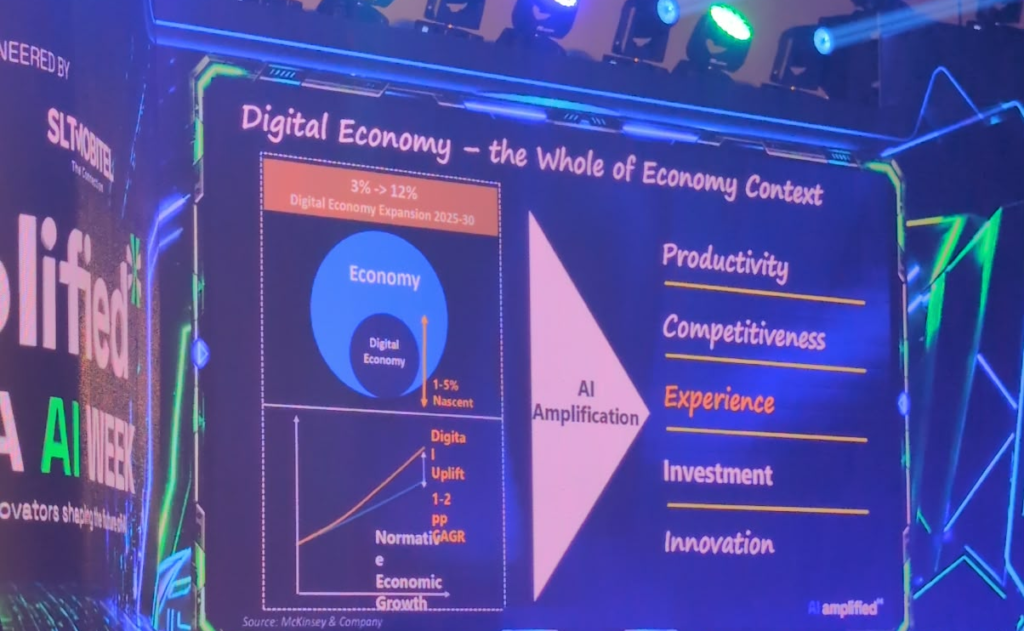
Addressing Sri Lanka’s positioning as a late starter in the global landscape, Dr. Hans Wijayasuriya, Chief Advisor to the President of Sri Lanka on Digital Economy, framed this delay as a direct opportunity to bypass legacy iteration loops and move straight toward shared architectures.
“In order to create a platform which helps us leapfrog into a point of leadership… having increased our consciousness of how AI can change lives, how AI can change business, and how AI can change the competitiveness of nations… conserving AI infrastructures, allowing these sectors to catapult and multiply their efficiency and productivity. While using shared components such as language, such as agents, and other AI infrastructures put together, you will have the best outcome from limited resources that we in a small country have.” – he said.

Dr Wijayasuriya also emphasised that the division of execution between public and private sectors must follow an 80/20 model, where the government builds 20 as a core platform enabler while the private sector multiplies that investment to deliver 80-percent of the industry innovation.
“The win here, the victory, the North Star, will be if government becomes an excellent platform and enabler. And it’s the private sector who multiplies that investment by 4x, or 8x, or 10x in terms of the innovation, in terms of the industry and sectoral uplift that they deliver on top of the common platform.
The 80/20 rule, meaning government builds 20, everyone else builds 80.” Expanding on this regulatory and institutional backbone, panellist Waruna Sri Dhanapala, Secretary of the Ministry of Digital Economy, noted that the state’s role should focus on establishing flexible operational institutions like GovTech alongside a Digital Economy Authority to regulate cybersecurity, personal data protection, and online safety under a unified umbrella.
“So, what I can say is the creation of institutions like GovTech, uh, to have a flexible and operational models with high credibility as well as legal, uh, validity. So, the next step is the creation of the Digital Economy Authority to safeguard as well as to regulate the entire digital ecosystem whereby we can also accommodate cybersecurity, personal data protection, uh, as well as online safety and many other aspects under one umbrella.” said Waruna.
The infrastructure discussions highlighted several considerations shaping the development of a more resilient, secure, and innovation-ready digital ecosystem.

The keynote speakers talked about the following:
- Building sovereign digital capabilities: Strengthening local digital infrastructure and developing sovereign capabilities are important considerations as organisations and public institutions navigate the balance between external service dependencies, operational resilience, and greater control over critical systems.
- Enabling innovation through shared infrastructure: Shared digital platforms, open APIs, and regulated sandboxes can create opportunities for independent developers and businesses to build, test, and scale solutions more efficiently, while supporting broader ambitions for technology exports and economic growth.
- Strengthening data governance and trust: Clear data classification practices, appropriate consent mechanisms, and robust transport security remain important elements of responsible data exchange.

Transitioning to Autonomous Agent Ecosystems
Operational discussions throughout the technical tracks focused on progressing across the AI Autonomy Matrix, by moving away from single-task productivity tools toward multi-agent orchestration across enterprise departments.
Regarding the critical mindset shift required when deploying enterprise systems, Varun Rastogi, Partner: Deloitte India, pointed out that organisations often ask what a licensed tool can do rather than identifying the exact operational problem that needs solving.

“The question has moved from what AI can do to what I want AI to do… Normally, conversation I’ve seen in industry starts with, ‘Okay, we have taken licenses, let’s see what can we do.’ But that should not be the right start. The right start is actually, ‘Okay, where should we apply?'” said Varun.
Rastogi further illustrated this shift by pointing to the rise of physical AI and digital twins, where companies run simulations and test components in digital scenarios before physical parts or tires ever hit the market.
Moreover, industry research indicates that enterprise deployments face steep execution hurdles. Historical data show that up to 70of enterprise AI projects fail to transition beyond the pilot phase into full production.
Bridging this gap requires addressing foundational data plumbing.
Panellists noted that rather than becoming stalled by personal data sensitivities, organisations can digitise historical records across general sectors like health, agriculture, and irrigation, or apply anonymisation and pseudonymisation techniques to train models safely under PDPA guidelines.
As Shevan Goonetilleke, CEO of GovTech Sri Lanka, noted, moving past initial roadblocks requires establishing trusted digital identity layers and secure rails through which data can legally pass.

“And I represent GovTech, where our mandate is to build the infrastructure layers, the digital public infrastructure that is required, and to build and orchestrate those platforms so the industry can then build applications on top of that. But for us to be able to do that, there are some foundational layers that need to come into play. First of all, having a trusted digital ID. Then you need to have the rails where data can legally and securely pass through from one…” -said Shevan.
Governance as Technical Engineering Rigour
When it comes to governance, Joseph Jones, Managing Director of The Artificial Intelligence Board, outlined the transition from passive ethical guidelines to active competence, transparency, and organisational structure.

“Competence, for me, is being able to say that somebody can do something at the right standard, at the right time, consecutively… Everyone needs to know about AI literacy. AI users need to have competence in what they’re doing… Managers need to know what their team are doing… Then we’ve got specialists.” said Joseph.
Furthermore, panellists expanded on this structure by emphasising that organisational heads must be held directly accountable for AI readiness, backed by proper human resources and infrastructure support.
However, while guardrails and compliance procedures are vital, speakers cautioned that regulatory frameworks must avoid becoming overly restrictive during early adoption phases so developers retain room to innovate.
“Yeah, I think regulation is important. You have to have a certain degree of regulations, but that should not stifle innovation. That is very important, especially at the initial stages… So we should allow the developers to have some room for their innovations and allow some mistakes,” said Dr. Mothilal De Silva, Group Chairman of Sri Lanka Telecom – Mobitel.

Key Themes Emerging from Sri Lanka AI Week 2026
Across the discussions at Sri Lanka AI Week 2026, several recurring themes highlighted the importance of building a strong foundation for sustainable enterprise AI adoption.
Beyond the capabilities of individual technologies, the broader takeaway was the need to align data infrastructure, business objectives, governance, and organisational readiness.
Four key themes stood out:
- Strong data foundations: Reliable, well-structured data pipelines and historical records provide an important foundation for more advanced AI implementations, including multi-agent systems.
- Purpose-driven AI adoption: The focus is shifting towards identifying specific business challenges and organisational objectives, ensuring that AI capabilities are applied where they can deliver meaningful value.
- Responsible data governance: Data classification, anonymisation, and appropriate consent mechanisms remain important considerations in protecting sensitive information and maintaining trust as AI adoption expands.
- Digital literacy and organisational readiness: Developing AI literacy across business users, leadership, and technical teams can help organisations navigate risks, strengthen decision-making, and support more effective adoption.