



A technology buyer can read the white paper, attend the webinar, revisit the pricing page and involve several colleagues, yet still decide to do nothing.
For years, digital demand systems have treated this behaviour as a strong buying signal. More activity meant greater intent; greater intent meant a higher probability of conversion.
However, that logic is becoming incomplete because in complex technology decisions, interest may open the conversation, but perceived risk determines whether the organisation can follow through.
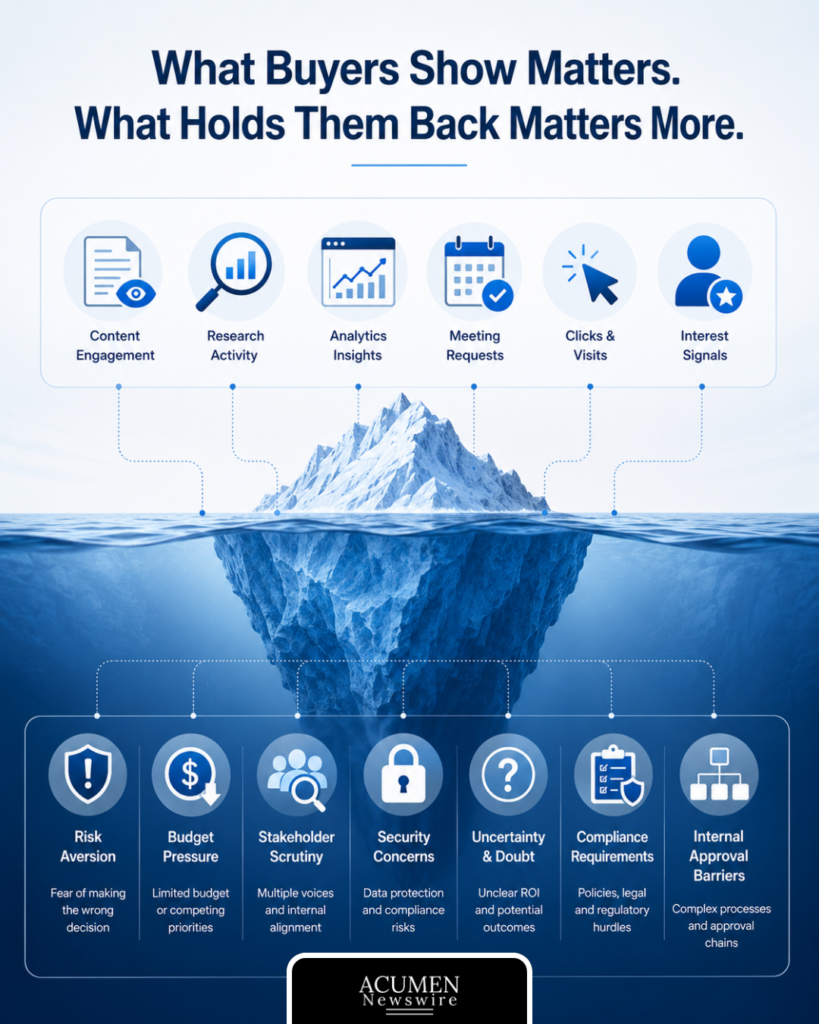
What Buyers Show Matters. What Holds Them Back Matters More.
Most engagement platforms detect positive movement such as repeat visits, content downloads, account-level topic activity, demo requests and product comparisons. Despite these indicators revealing what a buying group is exploring, it does not necessarily reveal what the buyer group is fearing.
For instance, a security leader may be interested in an AI platform while worrying about data exposure. Similarly, an operations team may see value in automation while anticipating implementation disruption. A CIO may support cloud migration but lack confidence in integration, governance or internal adoption.
These concerns appear in procurement questions, security reviews, trial behaviour, stakeholder expansion, delayed approvals and repeated requests for proof.
However, when those signals are not captured, an account can appear highly engaged while the decision itself is moving backwards.
The Rise of the Risk-Aware Buying Group
2026 buyer research shows how deeply risk shapes enterprise purchasing, because 94% of business buyers use AI during the buying process, but incomplete or unreliable answers are pushing them towards trusted people for validation.
Hence, the typical decision now involves 13 internal stakeholders and nine external influencers, with larger networks forming around more complex purchases.
This expansion acts as a distributed risk-control system.
For instance, security teams examine exposure; finance tests economic justification; procurement challenges commercial terms and performance claims; technical teams assess integration; and end users consider workflow disruption. External analysts, partners, and peers determine whether the provider’s story can survive independent scrutiny.
Moreover, research also found that procurement professionals are decision-makers in 53% of buying cycles, while more than 60% of buyers use some form of trial. Among purchases valued at $10 million or more, trial use rises to 78%.
These steps reduce uncertainty before accountability is attached to the decision.
Strong Intent Requires Stronger Confidence
Research found that 42% of CRM buyers used AI search during evaluation and that these buyers were 36% more likely to purchase. Moreover, AI search was the strongest predictor of purchase intent in the study.
Yet purchase probability is not the same as decision confidence. This is because AI can accelerate discovery, comparison and shortlisting while increasing the number of claims buyers must verify.
For instance, studies report that 67% of buyers prefer a representative-free experience, and 45% used AI during a recent purchase. However, confident buyers were twice as likely to report a high-quality deal as those with low decision confidence.
Therefore, digital autonomy increases the need for clarity, proof and reassurance rather than removing it.

Beyond Intent: Measuring Buyer Friction
Data-driven demand teams need a second layer of intelligence known as buyer-risk signals.
That means monitoring which stakeholders appear late, which security or integration content is repeatedly consumed, where trials lose momentum, which objections recur and whether buying-group activity is becoming aligned or fragmented.
Content should also be designed to address specific risks. Implementation roadmaps reduce operational uncertainty. Security documentation addresses exposure. Integration diagrams clarify technical feasibility. Customer evidence provides internal advocates with defensible proof. Role-specific business cases help finance, procurement, and technology leaders evaluate the same decision through different measures of value.
Therefore, engagement scores should be combined with stakeholder coverage, trial progression, objection data, technical validation and evidence of internal consensus, because a surge in activity may indicate growing interest, but it can also reveal a buying group searching urgently for reassurance.
Hence, the most valuable account is not always the one showing the most interest. It is the one whose unanswered risks can still be identified and reduced.
Therefore, the next generation of enterprise demand intelligence will not merely ask, “Who is looking?”
It will ask the more commercially important question:
“What is preventing this buying group from believing it can safely proceed?”