


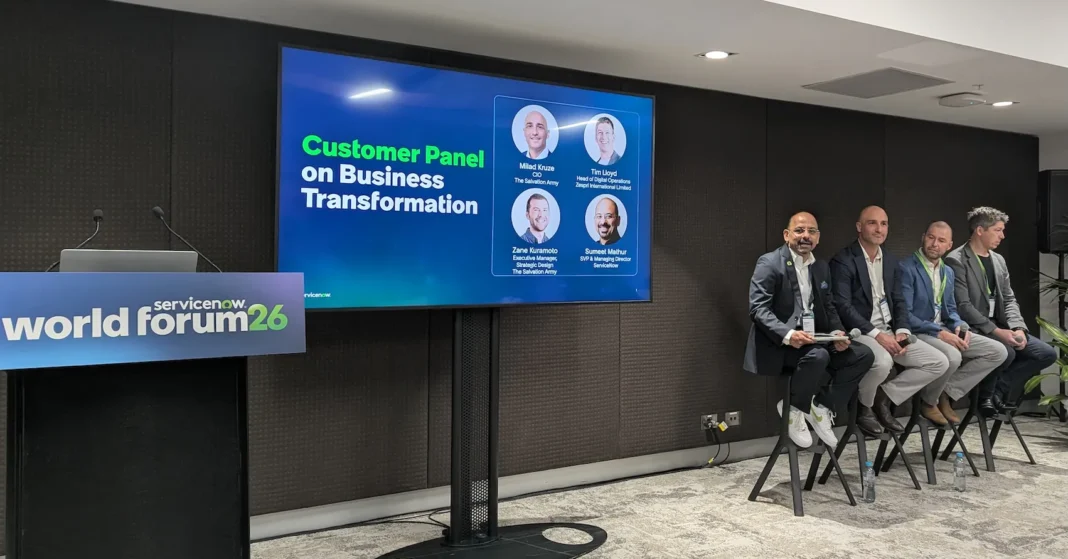
At ServiceNow World Forum Sydney 2026, leaders from two very different organisations – The Salvation Army Australia and Zespri International – shared how they’re using technology to drive meaningful change.
Day 1 of ServiceNow World Forum Sydney 2026, began with a customer panel moderated by SVP and MD of ServiceNow India, Sumeet Mather, and featuring leaders from The Salvation Army Australia and Zespri International.
After 145 years of growth, The Salvation Army Australia had accumulated what its leaders call an “administrative tax” on frontline workers – caseworkers juggling 20 different systems, multiple screens, and up to 65 open tabs when answering crisis calls.
To change this, the organisation created a frontline task force made up of staff across roles, states, and territories.
User research was a big part of the “re-design” and Milad Kruze, Chief Information Officer, Salvation Army Australia said, “We started quantitative and we did a year’s worth of our customers and our ticketing.”

Around 63,000 IT tickets were analysed over a year, out of which 24,000 were basic “search” and “how‑to” queries answerable by existing knowledge articles. Analysis uncovered that eighty-percent of tickets needed approvals which take an average 4.8 days (to respond to), a duration which is too long when it comes to crisis calls for assistance.
The solution that emerged is Goldie, an AI-powered digital assistant which now operates 24/7 across the Salvation Army to enable self-service for staff – finding answers instantly without trawling through systems and navigating processes to locate the right resources.
In just nine months, Goldie has handed back over 5,000 hours to staff, with 2,700 hours returned directly to frontline roles. By putting AI in front of legacy systems, it “insulates the change and complexity” of legacy and third‑party systems behind a consistent front end.
World-class supply chain
Zespri – the global kiwifruit marketer – is applying similar principles to a very different problem: keeping a complex, perishable supply chain running at pace.
Zespri operates physically in 26 countries, distributing kiwifruit into more than 50 markets worldwide. Rapid growth has doubled the organisation’s size in the past five to six years, while geopolitical uncertainty and the challenges of moving perishable goods across borders add layers of complexity. Against this backdrop, Zespri’s digital team has focused its AI and automation efforts on a simple idea: remove friction from the work that matters most.
So as opposed to reinvesting in time, looking at an end-to-end process, seeking endorsement from more people than really needed, we just got on with it.
Tim Lloyd
Tim Lloyd, Head of Digital Operations, Zespri International Limited, said, “You can see the low hanging fruit. So target it, improve the value. So as opposed to reinvesting in time, looking at an end-to-end process, seeking endorsement from more people than really needed, we just got on with it.”
One of the first and most significant initiatives was a complex integration between ServiceNow and SAP to overhaul how staff access SAP systems. By automating and streamlining this process – using workflow, integration, and intelligent routing – Zespri has cut provisioning times from days to minutes in many cases.
With AI and automation embedded in the plumbing of a critical process, and a clear business outcome – a major, time‑sensitive SAP transformation can proceed without being tripped up by access delays.
“It went from days sometimes to minutes in terms of their auto provisioning, and ultimately it helped enable our broader digital transformation programme to not have delays,” Tim said.
From the experiences shared by these two organisations, moderator Sumeet underscored the common thread that emerged – using AI to shield people from complexity so they can focus on what matters. Reflecting on the Salvation Army’s and Zespri’s journeys, he observed ultimately that it is about creating a stable, intelligent front door to get work done.
“So basically, you’re able to insulate the change and complexity of your legacy systems or third-party systems by having a front end that’s the go-to for your ecosystem.”
(This journalist was a guest of ServiceNow to its event in Sydney, Australia)