

Moveworks is leaning into a “front door to work” message as ServiceNow folds its 2025 acquisition deeper into its employee-experience strategy. The idea is simple – instead of sending workers to separate portals for IT, HR, finance, and business apps, Moveworks wants to be the first place they go to find information and complete tasks.
That message is now being reinforced by ServiceNow’s EmployeeWorks, which the company says is an AI-native front door that unifies conversational AI, enterprise search, and autonomous workflows.
In ServiceNow’s framing, MoveWorks powers the conversational layer while ServiceNow provides the governed workflow engine and employee-experience layer behind it.
Instant IT – the reason behind Movework’s genesis
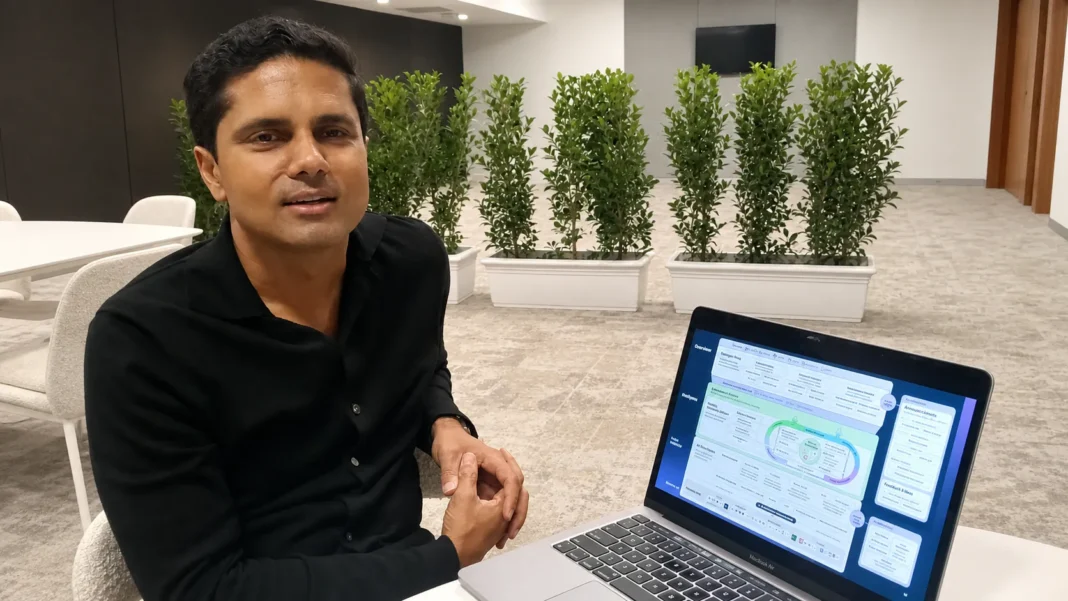
CEO and founder, Bhavin Shah, recalled how slow and manual basic requests were in large companies. “Just getting support was a very manual process. You’d ask for something, and it would take three days to get resolved. You’d ask for access; it would take two days for that to happen. And we were asking ourselves, why can’t this be automated? Why can’t I just chat and text something?”
“And we were asking ourselves, why can’t this be automated? Why can’t I just chat and text something?”
Bhavin Shah
This insight emerged in the era when consumer services were becoming “instant”.
“We asked ourselves, ‘Why is that not true for IT?’”, Bhavin said. This was the pain point MoveWorks wanted to solve when it started in 2016.
Building the front door to conversation
Bhavin shared that a co-founder, formerly from Google, had been working on core search. “He was doing that through a lot of machine learning techniques… statistical models and sliding windows… Bayesian trees, what we call the Stone Age of machine learning now.”
As transformers emerged, MoveWorks adapted its engineering approach. Around 2019, it began using BERT (a 100-million parameter transformer model) as the core of their language understanding for the chat assistant they had built.
Bhavin recalled the reaction it received.
“Large enterprises… were (expressing), ‘This is better than anything we’ve tried.’ Why? Because we were using the transformer architecture.”
It is worth noting here that the transformer architecture powers models like GPT, BERT, Claude, Gemini, and so on.
Moveworks also experimented early with GPT‑2 and GPT‑3 from OpenAI, and the arrival of GPT‑3.5 / ChatGPT in 2022 was the inflection point that let them rebuild the architecture and use large language models (LLMs) that could not only interpret questions but also plan and orchestrate actions across enterprise tools to deliver outcomes for a user.
Bhavin emphasised, “So in a way, we were seeing this evolve. We were using it way back before anyone was even talking about this.”
Connecting complicated questions
EITN also asked about what had to happen at the data layer, or workflow, or architecture so that the questions that employees asked would get the answers they needed.

Moveworks’ distinctive approach was to treat “data for AI queries” as a deep, actionable layer, not just a source of text for models to read. Its uniqueness comes from intentional choices that went beyond the usual “we have thousands of connectors” claim”.
Their marketplace shows the depth of their approach – around 121 plugins for Workday alone because “…we figured out all these small things and we give all those atomic actions, to the reasoner.”
Bhavin explained, “It was around 2019. We were building these connectors. There were no MCP servers (model context protocol servers). There was no A2A (Agent2Agent protocol). And it actually served us well because now our customers are loving the fact that we still have API capabilities for a lot of their core platforms.”/
The front door to work
Moveworks’ AI today can assemble and execute real cross-system workflows complete with audit trails and controls, not just answer questions. This is provided the integrations and permissions are configured for these systems like Workday, SAP SuccessFactors, Jira, Coupa, and SAP Concur.
The strategic shift matters because the product is no longer being sold as a chatbot that answers questions. Moveworks and ServiceNow are positioning it as an execution layer that can trigger approvals, update requests, and complete cross-system tasks within governed guardrails.
And this aligns well with ServiceNow’s goal to make available for employees, an AI-native front door that unifies conversational AI, enterprise search, and autonomous workflows.
(This journalist was a guest of ServiceNow to its event ServiceNow World Forum in Sydney, Australia)