

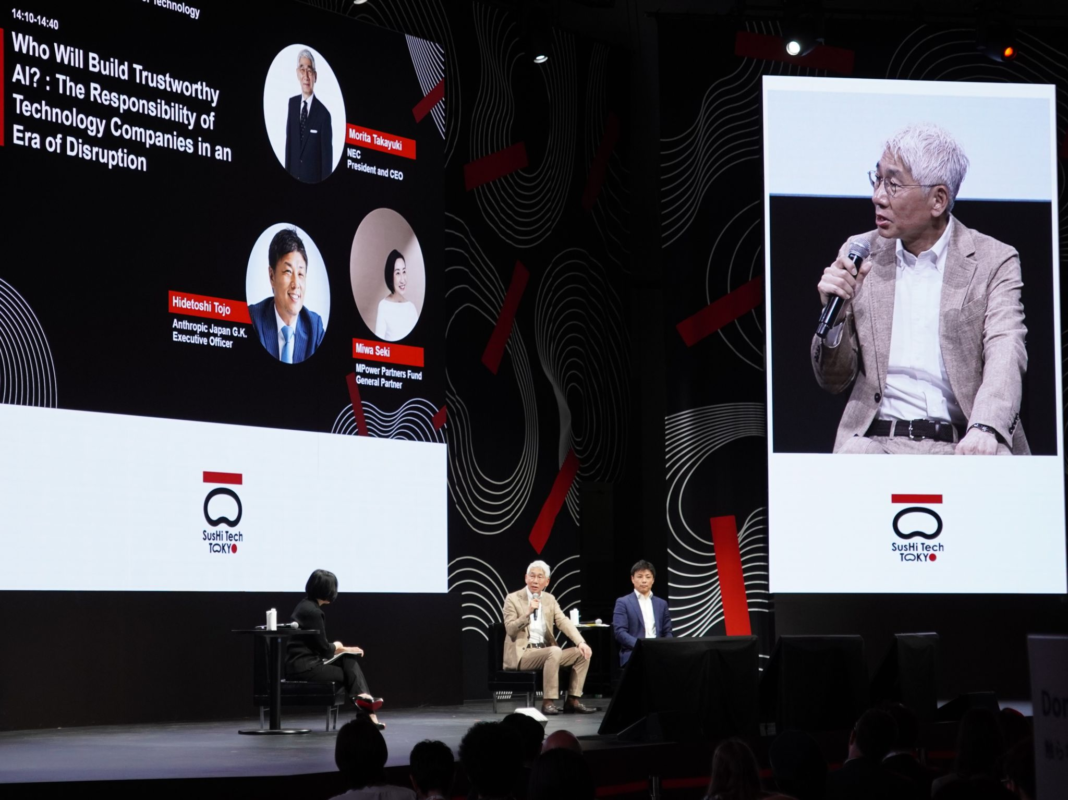
Trustworthy AI, a key narrative running through SusHi Tech Tokyo 2026, crystallised most sharply in one 30‑minute panel that posed a hard question to industry leaders – as generative AI turns into critical infrastructure, who will actually take responsibility for making it safe to use?
President and CEO of NEC Corporation Takayuki Morita and Anthropic Japan G.K. Head of Japan Hidetoshi Tojo sat down with moderator Miwa Seki, General Partner at MPower Partners, for a session titled “Who Will Build Trustworthy AI? – The Responsibility of Tech Companies in a Rapidly Changing Era.” Framed against a backdrop of rapid AI deployment and tightening regulation, the discussion focused on corporate posture: how large tech providers intend to balance speed, safety and economic security as models become more powerful.
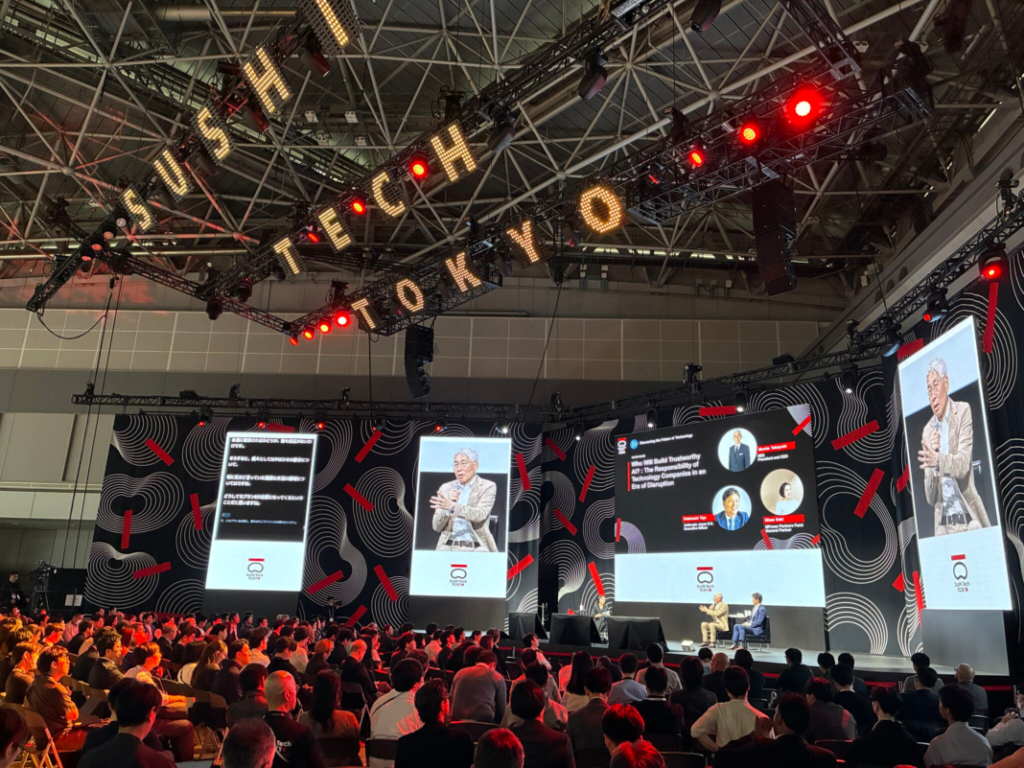
For Tojo, speaking later to Enterprise IT News via email, even the room itself was a signal. The size and engagement of the audience, he observed, underlined how quickly AI has moved towards becoming “critical infrastructure” in the eyes of individuals, businesses, governments and society. The central concern, and opportunity, is now whether that infrastructure can be trusted.
From horsepower to “harness” – NEC’s metaphor and Anthropic’s POV
One of the metaphors that stuck with Tojo from the panel came from his fellow panellist, Morita – AI as the horse, and governance as the harness that makes it usable and safe. In Anthropic’s reading of that analogy, the harness is built from explainability, predictability and accountability.
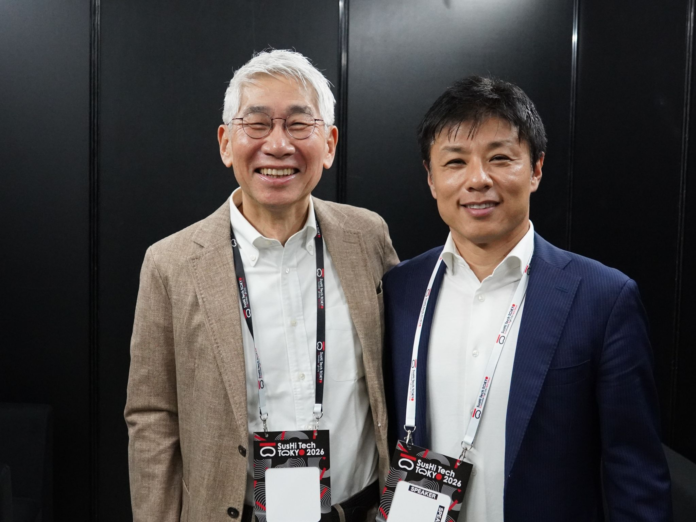
Tojo described Anthropic’s goal at the frontier of AI research as building systems where “users can understand why AI made the decision” and where its behaviour is predictable under real‑world conditions, and where those systems can be held accountable to societal expectations.
“That is what we mean by trustworthy AI; it is the standard we are working to reach at Anthropic as this technology becomes more capable and more deeply embedded in daily life, “ he said.
Sovereign AI and the “third option” question
The panel also touched on the increasingly prominent question of sovereignty. Morita has publicly articulated a vision in which Japan, alongside the US and China, develops its own large language model ecosystem as a “third option”, while also working with global players on rules and guardrails. Asked how Anthropic views that ambition, Tojo’s answer was notably pragmatic.
He said, “Anthropic sees Japan’s third option as something we can genuinely coexist with. For domains like defence, national security, and core government infrastructure, sovereign AI is clearly the appropriate answer.”
Market position may be a consequence of our work–and of course we want positive outcomes, but that will never be permitted to take precedence over our commitment to safety.
– Hidetoshi Tojo
In contrast, for areas like medical discovery, financial analysis or software development, being able to tap the world’s best frontier models quickly is itself a source of national competitiveness. In his framing, both paths “have a role, and the two approaches belong side by side”.
Within that coexistence, Anthropic is positioning itself less as a rival to sovereign AI and more as a partner that helps keep evaluation, safety criteria and data governance under Japanese control.

“That is why we signed an MOU with Japan’s AI Safety Institute to co-develop evaluation methodologies and internationally applicable benchmarks. This is also why the NEC partnership is focused on building sector-specific solutions designed around Japan’s compliance requirements,” he said.
NEC’s 30,000‑seat deployment: competition or something else?
NEC’s plans to roll out Claude across approximately 30,000 NEC Group employees worldwide can be widely read as one of Japan’s largest AI‑native engineering bets to date, and a major enterprise‑scale implementation of Anthropic technology in Asia Pacific.
It would be easy to frame this as a direct challenge to incumbents like Bing and Gemini that are already embedded in many work environments.
When asked the question, Tojo pushed back on that zero‑sum framing. Anthropic does not, he said, see the NEC collaboration as an attempt to “dethrone” other AI tools. Instead, the company’s internal compass points to something “a little different”: a founding principle that the development of safe AI comes first, and that market outcomes must remain secondary to that commitment.
From this perspective, the NEC deal is a “natural expression” of Anthropic’s safety‑first philosophy. In high‑stakes enterprise environments, where the consequences of error are significant, he argued, a rigorous focus on safety is precisely what makes an AI system most valuable.

Tojo said, “Market position may be a consequence of our work–and of course we want positive outcomes, but that will never be permitted to take precedence over our commitment to safety.”
Corporate responsibility in an age of uncertainty
Taken together, the panel and Tojo’s reflections sketch out a version of “trustworthy AI” that is less about marketing rhetoric and more about structural changes in how AI providers engage with regulators, sovereign ambitions and enterprise risk.
For Japanese enterprises and policymakers, a resounding message about AI from SusHi Tech Tokyo 2026 was that questions around who designs the harness – governance, evaluation standards and accountability – and who controls it, have become central to national competitiveness.