


Most enterprises in APAC remain at early to mid-level maturity in their use and governance of generative AI, even as AI‑driven cyber threats surge, according to a Forrester study presented to media during the Malaysia leg of Fortinet’s Accelerate roadshow.
The study commissioned by Fortinet, surveyed 585 APAC decision-makers and influencers about their organisation’s cybersecurity solutions.
It revealed interesting findings. For example, across APAC, organisations are planning to increase cyber security spending, with AI-related budgets rising even faster as they pour investment into AI-powered security operations, cloud security, and platform-based architectures. Malaysia’s figures on higher cyber and AI spend were presented as broadly representative of this regional trend.
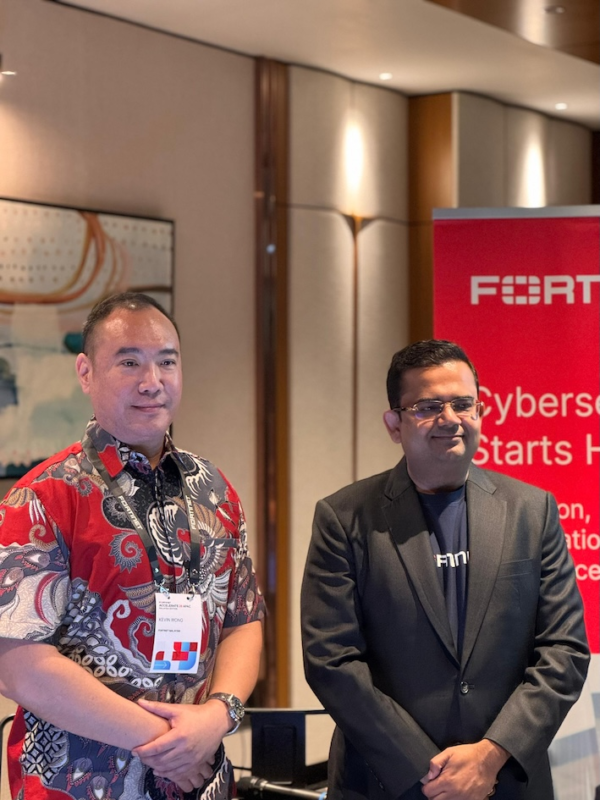
Kevin Wong, Country Manager, Fortinet Malaysia, commented, “Customers today are dealing with increasingly complex environments, where fragmented tools, limited visibility, and growing alert volumes are making it harder to detect and respond to threats effectively.
“At the same time, they are looking to leverage AI to improve speed and efficiency but often lack the integrated foundation to do so. At Fortinet, we are helping organisations simplify their security architecture and strengthen resilience through a unified, platform-based approach that brings together visibility, automation, and AI-driven intelligence.”
According to Rashish Pandey, VP of Marketing and Communications for Fortinet in APAC, organisations are placing significant expectations on AI to transform security operations, from improving detection to accelerating response.
“However, AI can only deliver meaningful outcomes when it is built on an integrated foundation. Without unified visibility and connected data across environments, AI risks amplifying complexity rather than reducing it. Integration is what enables AI to operate at scale and deliver real security impact.”
Rashish also shared customer feedback that reflects a growing realisation of the benefits of integrating cybersecurity solutions, as well as the need to leverage AI to combat AI-driven threats.
APAC AI maturity levels
Beginner
Organisations have little visibility into which AI tools employees are using, with heavy “shadow AI” from unsanctioned services and almost no formal policies or controls around generative AI.
Intermediate
IT and security teams have some insight into AI usage and have started rolling out basic policies, but visibility is incomplete and there is no fully defined, organisation‑wide AI strategy or governance model.
Advanced
Enterprises have central visibility and control over AI tools, clear and enforced governance, minimal shadow AI, and generative AI is deliberately integrated into core processes, including cyber security operations and risk management.
In APAC, 60-percent of organisations sit at intermediate maturity, while only one in six have reached the advanced stage.
The Malaysian snapshot: AI and cybersecurity readiness
Top rising risk
About 70-percent of Malaysian respondents said AI-driven threats are their single largest rising cyber risk.
Tool sprawl
64-percent cited fragmented cybersecurity tools as a major internal challenge.
Alert overload
Around 63-percent alert overload as a top security operations issue.
AI maturity
Roughly two-thirds of organisations are still in the beginner to intermediate AI maturity bands, mirroring the APAC pattern with only a minority in the advanced tier.
Platform shift
Platform‑based security adoption is expected to climb from the 30‑plus percentage range to above 50-percent over the next 1–2 years, as Malaysian enterprises move away from pure point solutions.
Embedding AI into security ops – Best practices for APAC
The media briefing also revealed a few ways that organisations in the region can operationalise AI.
- Turning security operations centres or SOCs into “AI SOCs” to cut detection and response times, and automate alert and triage across multiple tools.
- Consolidating point products into integrated platforms first, then layering AI on top so it has cleaner data and end‑to‑end visibility.
- Treating AI as a horizontal capability embedded across many security products (network, endpoint, SASE, cloud), not as a single standalone tool.
- “Fighting AI with AI” by using it to spot patterns at scale, automate blocking and quarantine, and counter AI‑driven phishing and other attacks
Rashish said, “For customers who are moving towards a platform approach, 90-percent said, ‘I can see a measurable improvement in my response time when it comes to a platform-focused approach’ and 60-percent said, ‘I am better by at least 10-percent than where I was when I was just going through point products.’