



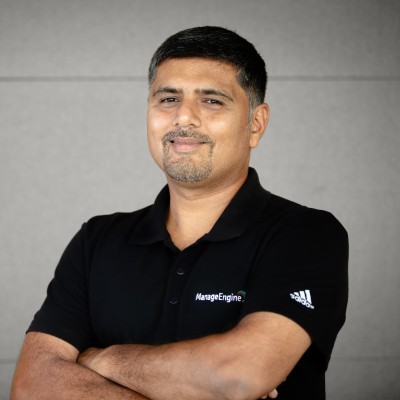
ManageEngine is a major division of AdventNet which became Zoho Corporation in 2008. Arun Kumar, regional VP in APAC for ManageEngine, described ManageEngine as one of two major divisions of Zoho Corporation.
While ManageEngine spans six major IT verticals from IT service management and full-stack observability to endpoint security, identity and access management, low-code platforms, and IT analytics, Zoho.com focuses on business applications like CRM, HR, finance, and collaboration tools.
Independence
A key theme in the company’s evolution is its status as a privately held, self-funded business, which Arun pointed out has given it the freedom to take a long-term view.
“We always try to do what is right for our customers, our partner,” he said. “That long term vision really helped… we were able to look at what we can do for 10 years, 20 years and so on.”
Freedom, passion, and purpose to solve some real demands in IT management led to many products being built from scratch. “None of these were acquired or from mergers. We were very receptive to technology shifts happening in the market.”
When this started, products were completely on-premise till about 2005 when cloud technology evolved and Zoho started innovating on this platform.
From free tools and trial versions to a consultative approach
ManageEngine’s low-touch sales cycle model according to Arun meant free tools and trial versions that were offered online. “Customers feel there is value, they buy it online and start using it.”
Initial traction came from English-speaking markets where there was huge IT adoption, and this surely and gradually scaled to other non-English speaking countries in Middle East and Southeast Asia regions.
Arun explained that this happened through their channel partner ecosystem, typically partners that represent ManageEngine in a particular region and would do localisation, regional marketing initiatives, and be the first point of contact for customers in terms of solving their technical problems, implementation, and support.
As the portfolio matured and adoption extended into mid-sized and large enterprises, the sales motion had to change. Enterprise IT buyers wanted guidance on transformation, architecture and compliance, not just tools. And as its solutions started to gain traction in larger enterprises, a more consultative approach was called for.
Zoho began life as AdventNet in 1996 focused on building developer tools and network management platforms for large telco companies. Arun shared its original objective was to provide simple, effective tools that telcos could build on top of to meet their specific requirements, such as via an SNMP API and network management solutions. In around 2000, the company was responding to the lack of robust IT management options for small and medium businesses, and started to pivot to also “solving their specific IT challenges.
Because of a model that resulted in practical and affordable ways to manage servers, assets, and networks, the company scaled with customer demand for more requirements. To date, it offers over 60 products. Arun explained, “Today, we are a more integrated, scalable, unified platform serving the real large enterprises of the world, but we still keep our model very modular, which means small and medium businesses can still pick and choose what they want.”
Arun noted that with large enterprises it is not so much about addressing specific pain points and more about transformation. “So, how do you evolve your organisation? How do you completely automate your IT? How do you do end-to-end management?
“You look at broader business goals rather than solve technical problems with products. This requires a lot of face-to-face discussions because these aren’t box-shifting products – instead there is a lot of customisation, integration, sometimes migrating the data from legacy systems.”
In this way, ManageEngine started expanding in 2015 and today, they have over 30 offices across the globe including Malaysia.
So the idea of hiring, opening offices and building a technical and customer-facing team is also to enable and support its partner ecosystem.
This could not come at a better time as Arun noted conversations about regulations and compliance becoming more active in each of its major markets. “Each country now talks about data sovereignty, data protection laws, and each industry vertical also comes with a lot of compliance like HIPAA, PCI-DSS … so this requires a good end-to-end consulting approach that enterprise customers expect.
“This confidence and assurance has to come from the vendor.”
Growth and data centres
Over the past decade, ManageEngine’s revenue mix has shifted from being heavily Western-centric to much more geographically balanced. Before, about 60- to 70-percent of revenue came from the US and other Western markets, but today the revenue mix is increasingly adding share from developing regions such as Southeast Asia, India, Latin America, and the Middle East.
While we try to coexist with other vendors, we also try to make our own products more integrated, more contextual, so that customers see continuous value. Because your product is always your core foundation … So we have to ensure we equally spend and invest in that direction as well.
Arun Kumar
These are markets that Arun says are in ‘hyper-growth’ phase at around 25- to 30-percent annually
ManageEngine’s independence underpins how it approached the shift to cloud technology. According to Arun, the organisation’s “privacy‑first, security‑first” stance is why it invests so heavily in owning the full stack – space, power, hardware, and software – so that “the data we manage, the data we handle… directly comes from us, not through any third party contracts” and customer data is never used for marketing or shared across tenants.
“We run and manage close to 20 data centres across the globe… these are all our own data centres, the space and power we run and manage, including the framework, the hardware and everything.”
Democratising AI
Looking ahead, Arun frames the next five years as being “big time” about AI, but stresses that AI only delivers real value when enterprises have achieved a solid level of digital maturity. That means clean, connected data, strong workflows, and reliable analytics – otherwise “the accuracy of AI could be a challenge.”
ManageEngine is embedding AI/ML natively into its products, integrating with public LLMs, hosting open-source models in Zoho’s own data centres, and developing narrow language models tailored to IT operations. All these are fronted by the Zoho Intelligence Assistant or ZIA and the ZIA Agent Studio. As before, Zoho wants AI capabilities like ZIA to be yet another feature functionality that comes with its products.
Arun opined, “While we try to coexist with other vendors, we also try to make our own products more integrated, more contextual, so that customers see continuous value. Because your product is always your core foundation … So we have to ensure we equally spend and invest in that direction as well.”