


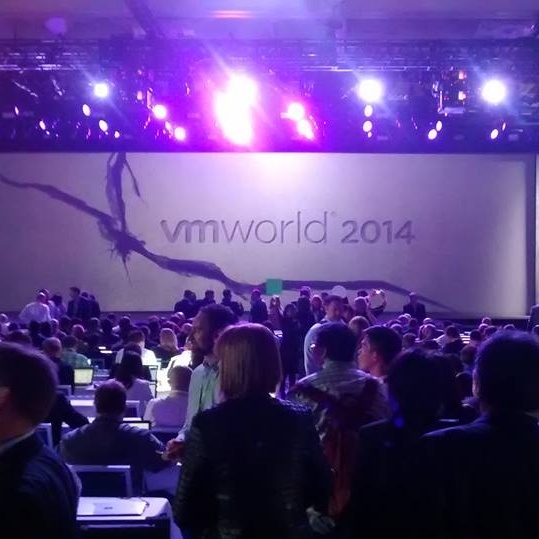
VMware has just concluded a few significant announcements on day one of their annual tech and partner conference in San Francisco, VMworld 2014. Of note, were announcements of solutions which fast forwards the software-defined data centre into reality.
This is very commendable effort given it was not very long ago (less than a year) that VMware began to offer not only virtual compute, but virtual versions of network and storage, the two other underlying infrastructure components of a data centre.
However, it was their VMWare distribution of OpenStack which raised the most eyebrows, as well as, drew the most questions from the media, during a press conference after keynotes were done for the first day.
One telling comment from a sales engineer of a very significant VMware partner was , “It’s a case of keeping your friends close, but your enemies closer.”
When other tech solution vendors describe IT environments, they also seldom portray VMware ones as simultaneously being OpenStack-powered as well.
An early access customer, the Massachusetts Institute of Technology (MIT), had even admitted that they were sceptical about integrating these two environments.
During day one general session, MIT Senior Manager, Garry Zacheiss told thousands of attendees that the early initial scepticism was over how “it might introduce some complexity” into their environment.
So, the press conference after, was enlightening as journalists from around the Asia Pacific and Japan region, tried to wrap their heads around the idea of a VMware distributed OpenStack software.
VMware distributed OpenStack
VMware’s CEO, Pat Gelsinger described, “It does include vSAN, vSphere, ESX, NSX…it does include VMware components as part of that solution and that is the value proposition to the customer, because now they can add OpenStack to their environments, building on top of all the virtualised environments they have, without having to build a new discrete infrastructure.”
“This is by far the easiest, most efficient and most cost-effective way for them to be able to deliver OpenStack.”
What VMware will be doing is delivering developer-friendly OpenStack APIs and tools, for creating a software-defined data centre (SDDC), on top of VMware infrastructure. This distribution will also enable corporate IT to manage and troubleshoot an OpenStack cloud with the same VMware management tools.
COO, Carl Eschenbach had also alluded to the support that VMware customers would get when they try to extend their IT footprint by standing up an OpenStack platform.
He said, “The other thing we hear from customers who start their journey down the OpenStack path, is that they start off thinking it will be easy to implement, and it will be with support from their own developer community.
“In reality, they often come back to us and say, ‘VMware we want your help. We haven’t successfully stood up an OpenStack environment that we want to integrate on top of what we already have in the data centre.”
According to him also, VMware will support their customers who take on VMware’s distribution of OpenStack. “You don’t need to go to another party for support services. We are bundling that together.”
The virtualisation company was also careful to point out, that they are already ranked fourth, in terms of code contribution to OpenStack framework pieces like Nova (compute), Neutron (networking), Cinder (block storage), and more. According to a press release, they have a team of 30 developers who are dedicated to OpenStack.
To date, this distribution which VMware is branding as “VMware Integrated OpenStack” has early access customers like MIT, Ford, Apollo Education Group and more. It went into beta stage yesterday and general availability is slated for the first half of 2015.
More than one VMware customer who’d gone up on stage during general session, had professed that the hybrid cloud is inevitable, that it’s in their future and here to stay for the long term.
The same could be said about OpenStack in their future, which Gelsinger had described as ‘unavoidable’ when he spoke with analysts.
The second eyebrow raiser
That wasn’t the only announcement that raised eyebrows. The other was about faster and lighter enterprise-grade ‘containers without compromise’ that VMware wants to deliver.
One popular industry view is that Red Hat popularised container technology when their latest operating system offered integration with this extremely resource-efficient virtualisation technology.
At a glance, it seems that there is competition between VMware’s bread and butter virtual machines and containers, too.
And then, during his keynote, Gelsinger unveiled Project Fargo, an effort with the objective of enabling faster and more secure containers, ON TOP OF virtual machines.
Gelsinger had described container technology as an old technology, which recently began to emerge very quickly. He observed that while there is a lot of excitement about container technology, it’s still too early to tell how things will pan out, with regards to how containers, containerisation of applications and tools around it would be developed.
To help all that along however, VMware is collaborating with Docker, Google and Pivotal CF to make the technology more mainstream in the industry.
Each of these partners already have some version of container technology – Google with their open source container manager, Kubernetes, Docker with their Linux-driven commercial containers, and Pivotal Cloud Foundry which uses containers, but in virtual machines.
How does VMware’s PaaS sibling, Pivotal, feel about container technology in their future?
Pivotal’s Head of Product Group for Pivotal, James Watters had posted on Twitter after the announcement that, “With OEM of Pivotal CF, VMware is already driving more revenue based on containers in the enterprise, than any vendor on earth.”
He had also pointed out, “People forget that VMware was doing containers with CloudFoundry in 2010, before they were grassroots popular.”
Conclusion
The word ‘micro segmentation’ also came up during the key note and Gelsinger with Eschenbach had tried to get some excitement out of journalists, around it during the press conference.
But, ‘micro segmentation’ was well and truly overshadowed by VMware’s announcements about embracing ‘pseudo-competitors’, OpenStack and container technology, on day one of VMworld 2014.
(This journalist was a guest of VMware’s to VMworld 2014 in San Francisco)